
Key Observations
- Physical AI technology trails knowledge-based AI but is gaining ground rapidly.
- Recent massive investment into robotics and other physical AI is helping close the training-data gap versus the internet-based data that trained large language models (see below for details).
- Venture capital investment into humanoids ($5.1B in the first four months of 2026, already above the full-year 2025 total of $4.8B and roughly 3x the 2024 level of $1.7B) and into robotics and physical AI as a whole ($28.7B in 2025, double the previous high, and $33.4B in the first half of 2026 alone) has increased dramatically since 2025.[6]
- Shipments are following the money: more than 22,000 humanoids shipped worldwide in the first half of 2026, close to four times the year-earlier level, though more than 60% went to entertainment, data collection and research rather than factory or warehouse work.[7]
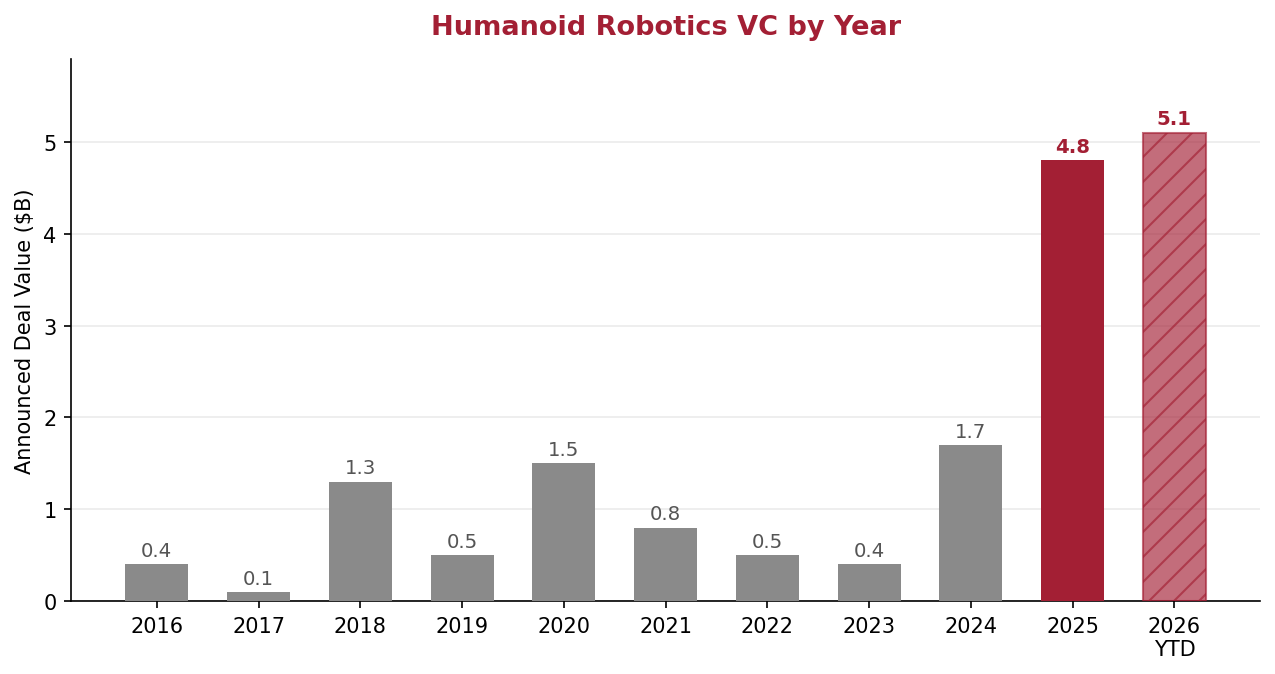
Humanoid Robotics VC by Year, 2016–2026 YTD (announced deal value, $B, global) | Source: PitchBook, as published in “The limits of VC’s humanoid bet”; data as of April 29, 2026. 2026 bar is partial year. Values transcribed from PitchBook’s published chart.
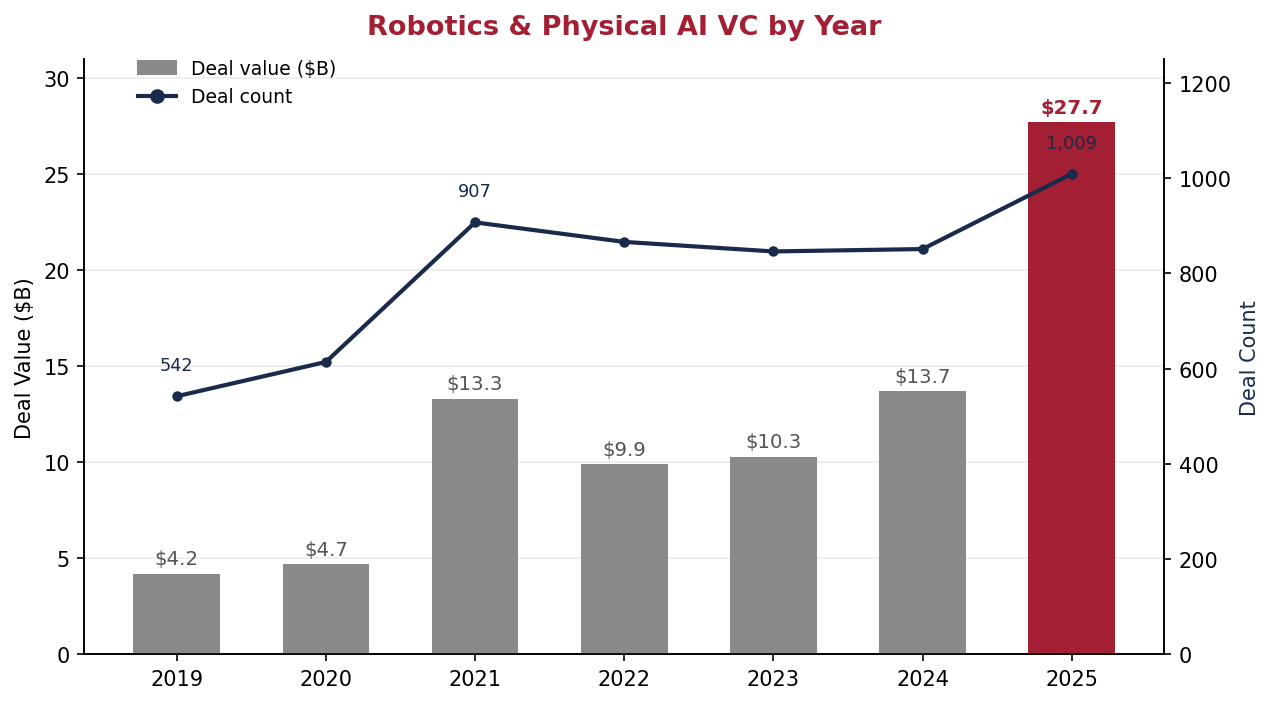
Robotics & Physical AI VC by Year, 2019–2026 H1 (deal value $B and deal count, global) | Source: PitchBook, Q2 2026 Robotics & Physical AI Report (published Sept 1, 2026); data as of June 30, 2026. The 2026 bar covers January to June only.
Within the 2025 sector total, PitchBook’s year-end report broke venture funding down by vertical as follows:[1]
- Defense and security: $8.0 billion across 234 deals, including $6.2 billion for uncrewed aerial systems.
- Industrial: $5.9 billion, up 70% year over year, led by assembly and manufacturing robots at $4.2 billion.
- Robotics software and AI: $3.4 billion, including $2.5 billion for AI autonomy platforms, anchored by Physical Intelligence’s $600 million round at a $5.6 billion post-money valuation.
- Logistics and warehousing: $1.2 billion, down 28.5% year over year, a rotation away from the maturing warehouse AMR category even as deployed systems scale.
- All other verticals: approximately $9.2 billion, the balance of the total.
Humanoid-specific funding cut across these verticals at $4.8 billion, roughly 17% of the 2025 sector total, or about one in six dollars.
The first half of 2026 has already exceeded all of 2025: $14.8 billion in the first quarter and a record $18.6 billion across 450 deals in the second, for $33.4 billion in six months. The quarter was top-heavy. Three financings (Anduril’s $5 billion, NEURA Robotics’ $1.4 billion and Physical Intelligence’s $1 billion) made up 40% of second-quarter value, and PitchBook notes that excluding Anduril the quarter was down 8% on the first; funding for logistics and warehousing robotics fell 68% quarter on quarter as capital moved toward autonomy platforms and components.[6]
Exits: The First Real Liquidity
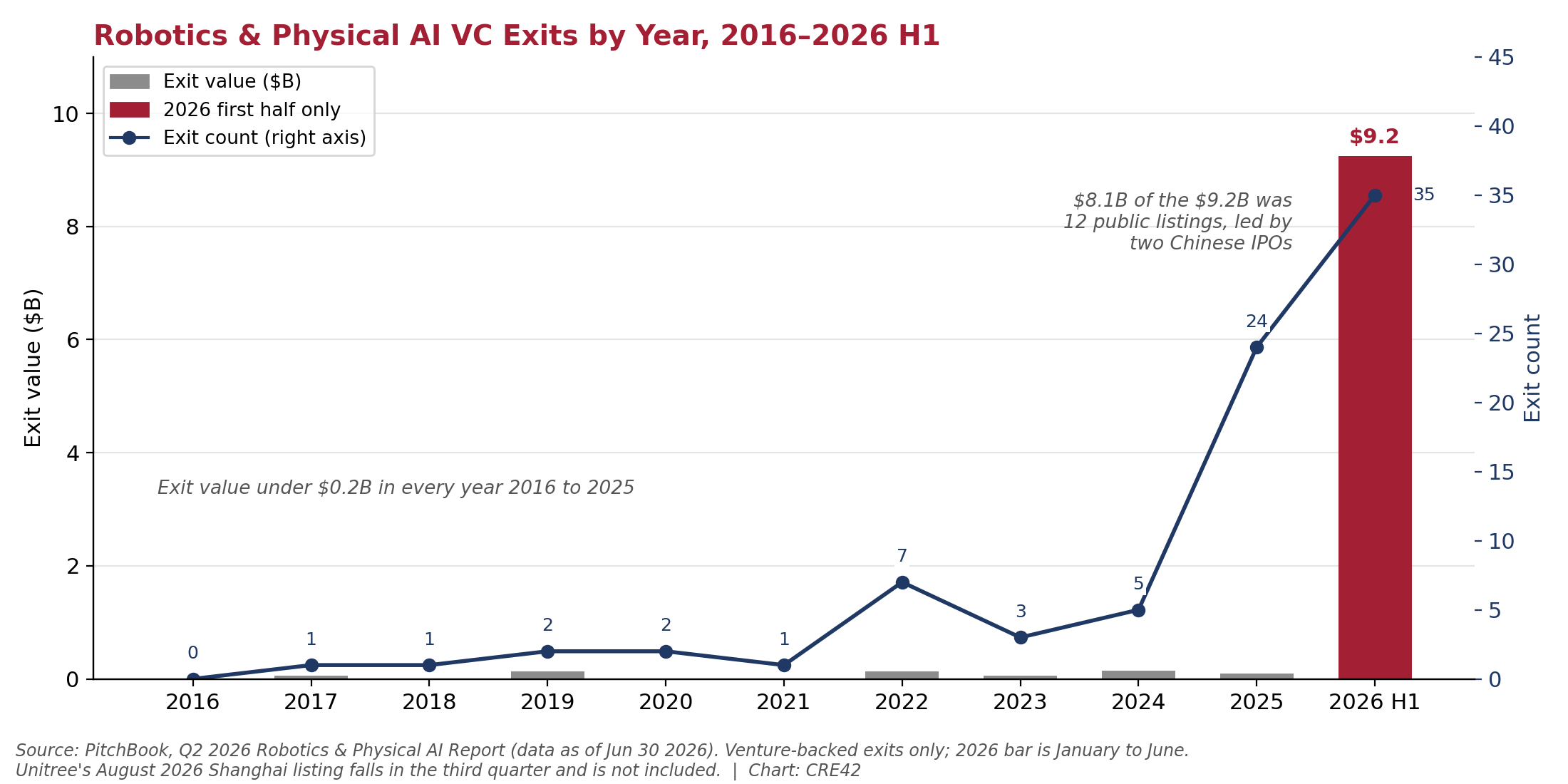
Robotics & Physical AI VC Exits by Year, 2016–2026 H1 (exit value $B and exit count, global) | Source: PitchBook, Q2 2026 Robotics & Physical AI Report; data as of June 30, 2026. The 2026 bar covers January to June only.
For a decade the money went in and almost none came out: venture-backed robotics exits totaled less than $0.2 billion in every year from 2016 through 2025, even as annual investment climbed past $28 billion. The first half of 2026 broke the pattern with 35 exits worth $9.2 billion, $8.1 billion of it from 12 public listings. Two Chinese IPOs in the second quarter, SEER Robotics ($1.5 billion, navigation software) and Nanchang Sanrui ($1.3 billion, actuators and motion components), were 96% of the quarter’s exit value; neither makes a robot, which PitchBook reads as public markets finding liquidity in the enabling layers of the stack before the robot makers themselves. Acquisitions held up in count (10 in the quarter) but disclosed value fell to $42 million.[11] The third quarter will add the two humanoid listings that matter most for this page, Unitree’s August IPO and, if it closes on schedule, Agility’s SPAC, so the exit line is likely to move again before year-end. For investors, the point is that the sector now has public marks, and the first ones favor components and software over finished humanoids.
Projected Deployment: Announced Targets
Deployment in 2026 is concentrated in automotive and warehouse settings, where structured, repetitive tasks and high existing automation lower the integration barrier. The automakers are leading their own rollouts: BMW with Figure, Mercedes-Benz with Apptronik, and Hyundai through its ownership of Boston Dynamics. Announced timelines run in years, not quarters; Hyundai’s target of parts sequencing by 2028 and component assembly by 2030 is representative of how gradual the rollout is even for a vertically integrated manufacturer. The concrete figures that exist are operating hours and unit counts at single sites, not fleet-scale production.
| Company / Robot | Deployment | Timeline | Status (Sept 2026) | Primary source |
|---|---|---|---|---|
| Boston Dynamics Atlas (Hyundai) | Hyundai Metaplant America, Savannah GA: parts sequencing, then component assembly | Sequencing 2028; assembly 2030 | Product Atlas unveiled at CES 2026; 30K units/yr production system targeted by 2028; May 2026: Hyundai commits 25,000 units to its own plants (Savannah 2028, Kia Georgia 2029), subject to a labor agreement its Korean union has not yet given | Hyundai newsroom, Jan 5 2026; JPMorgan investor session, May 20 2026[3][10] |
| Figure (02 → 03) | BMW Spartanburg, SC: sheet-metal loading (02), then production logistics/sequencing (03); European plants under evaluation | 02 pilot 2024–25; 03 in 2026 | Figure 02 pilot completed (30,000+ BMW X3s, ~1,250 hrs); Figure 03 arrived at Spartanburg Jun 30 2026 for sequencing and logistics; fleet size not disclosed | BMW Group / Figure AI[4] |
| Tesla Optimus | Tesla factories (learning); Fremont production line | “Soon” (Q2 2026 call, Jul 22); no date given | Pre-production; first-generation Fremont line being installed; first units to go to an internal “Optimus Academy” for training, not customer work; no 2026 unit target | Tesla Q4 2025, Q1 and Q2 2026 calls[2] |
| Agility Digit | GXO (Flowery Branch, GA), Amazon: tote handling; Toyota RaaS pilot | Commercial since 2023 | 100,000+ totes moved at GXO; 65,000+ hours of real-world operation per its June 2026 filings; the only Western humanoid with disclosed commercial revenue; going public via SPAC at $2.5B | Agility / GXO; Churchill Capital XI filings[9] |
| Apptronik Apollo | Mercedes-Benz (automotive); GXO (warehouse) pilots | Pilots 2025–2026 | Pilot; $935M+ Series A (Google, Mercedes, John Deere) | Apptronik / Mercedes-Benz |
| Hexagon AEON (BMW) | BMW Plant Leipzig (Germany): high-voltage battery assembly, component manufacturing | Pilot phase summer 2026 | Test deployment Dec 2025; wheeled humanoid; BMW’s first European Physical AI deployment | BMW Group press[4] |
The fastest manufacturing ramp belongs to Figure, whose own account puts BotQ output at one Figure 03 per hour, a 24x improvement in under 120 days, with more than 350 third-generation robots delivered. Production volume, however, is not the same as productive deployment: most units to date are allocated to internal research, data collection, and pilot programs rather than autonomous work on a customer line.[5]
What to Watch in 2026
| Subject | Key Source(s) | Expected Next Release |
|---|---|---|
| Humanoid robot shipments & market share | Counterpoint Research Humanoid Tracker | Semiannual; H1 2026 update published Aug 20, 2026. Next: full-year 2026, expected Jan 2027 (Counterpoint forecasts 50,000+ units for 2026) |
| Tesla Optimus Gen 3 deployment data | Tesla quarterly earnings calls | Q3 2026 results: late Oct 2026. Key questions: whether Fremont production has started, and any unit count or customer beyond the internal training program |
| Unitree (SSE 688836) and Agility (SPAC) as public companies | Shanghai Stock Exchange filings; SEC EDGAR (Churchill Capital XI) | Unitree listed Aug 19, 2026; first half-year report as a listed company due early 2027. Agility SPAC close expected end 2026. Both bring audited unit and revenue data to a sector that has run on press releases |
| Boston Dynamics Atlas / Hyundai deployment | Hyundai Motor Group newsroom; Boston Dynamics | First Atlas shipments to Hyundai plants due 2026; HMGMA sequencing 2028. Watch for the labor-management agreement in Korea that the union has made a condition of deployment |
[1] Vertical breakdown from PitchBook, Q4 2025 Robotics & Physical AI VC Trends (Emerging Tech Research, published Mar 19, 2026; data as of Dec 31, 2025), which put 2025 at $27.7 billion across 1,009 deals. The chart above uses PitchBook’s Q2 2026 report (data as of Jun 30, 2026), which restates the series as the database is updated: 2019: 4.3 / 563; 2020: 4.8 / 653; 2021: 14.0 / 984; 2022: 10.1 / 937; 2023: 10.8 / 962; 2024: 14.2 / 992; 2025: 28.7 / 1,545; 2026 H1: 33.4 / 974. The vertical figures below are from the earlier vintage and sum to that total. 2025 segment leaders: defense & security $8.0B (234 deals; UAS $6.2B); industrial $5.9B (+70% YoY); software & AI $3.4B; logistics & warehousing $1.2B (−28.5% YoY). pitchbook.com ↩
[2] Tesla Q4 2025 earnings call (Jan 28, 2026): Model S/X programs ended to free Fremont capacity for Optimus; Musk acknowledged zero Optimus units doing useful work. Tesla Form 8-K (Jan 28, 2026) lists Optimus capacity status as “Construction.” Q1 2026 earnings call (Apr 22, 2026): start of production late July or August 2026; initial output “quite slow”; no 2026 production target. Q2 2026 earnings call (Jul 22, 2026): “we will soon start production with Optimus”; the Fremont line is being installed “in place of what used to be the Model S, X production”; first robots to practice tasks in the “Optimus Academy”; “the initial portion of the S-curve will be quite flat and long because of the newness of the parts”; “the hardest product to scale manufacturing that we’ve ever made at Tesla, because everything on the robot is new.” No unit figures given. ir.tesla.com ↩
[3] Hyundai Motor Group, “Hyundai Motor Group Announces AI Robotics Strategy to Lead Human-Centered Robotics Era at CES 2026” (newsroom, Jan 5, 2026). Boston Dynamics product Atlas: 56 degrees of freedom, lifts up to 110 lb (50 kg), automatic battery replacement. Deployment at Hyundai Motor Group Metaplant America (Savannah, GA): parts sequencing beginning 2028, component assembly by 2030. Group target: a production system capable of 30,000 robot units annually by 2028. Boston Dynamics–Google DeepMind partnership for next-generation humanoid AI. hyundai.com ↩
[4] BMW Group, humanoid robot deployment press releases (2025–2026); Figure AI, “F.02 Contributed to the Production of 30,000 Cars at BMW” (Nov 2025). Figure 02 ran an approximately 11-month pilot at BMW Spartanburg, contributing to 30,000+ BMW X3 vehicles and moving 90,000+ components over ~1,250 operating hours; BMW is deploying Figure 03 for production logistics/sequencing and began a Leipzig (Germany) pilot using Hexagon’s AEON robot, pilot phase summer 2026. bmwgroup.com / figure.ai ↩
[5] Figure AI, “Ramping Figure 03 Production” (figure.ai, Apr 29, 2026). BotQ (California) production scaled from one Figure 03 per day to one per hour, a 24x throughput improvement in under 120 days, with over 350 third-generation robots delivered. figure.ai ↩
[6] PitchBook, Q2 2026 Robotics & Physical AI Report: The Money Is in the Motion (published Sept 1, 2026; data as of Jun 30, 2026): $18.6 billion across 450 deals in Q2 2026, up 25.3% from a revised $14.8 billion in Q1 and 47.9% year over year, the strongest quarter on record; Anduril ($5.0B), NEURA Robotics ($1.4B) and Physical Intelligence ($1.0B) were 39.8% of quarterly value; excluding Anduril, Q2 was down 8.3% on Q1; logistics and warehousing VC fell 68% from Q1; AI and autonomy platforms $7.7 billion trailing twelve months. Annual series as in footnote [1]. Preview PDF and data pack held in the CRE42 source folder. pitchbook.com ↩
[7] Counterpoint Research, “Global Humanoid Robot Shipments Soar Nearly 300% YoY in H1 2026, Driven by Commercial Deployments” (Aug 20, 2026), figures as reported by Forbes the same day: more than 22,000 units shipped globally in H1 2026; Agibot about 9,700 units (43%+), Unitree 7,000+ (31%), Galbot about 5%, UBTech 4.4%, Leju 2.9%; entertainment, performance, data production and research 60%+ of shipments, industrial manufacturing 13%, warehousing and logistics 5%; Counterpoint forecasts more than 50,000 units in 2026 (+210%). China’s Humanoid Robot Scene Application Alliance separately reported 30,000+ units shipped within China in the half. Agibot’s 15,000th robot (all form factors, company-reported) per PitchBook Q2 2026. counterpointresearch.com ↩
[8] Unitree Robotics IPO on the Shanghai Stock Exchange STAR Market (ticker 688836): priced Aug 11, 2026 at 150.8 yuan, raising about 6.1 billion yuan ($905 million) with the retail book oversubscribed more than 8,000 times (Quartz, Aug 11, 2026); debut Aug 19, 2026 closed at 845 yuan, up about 460%, for a market value of roughly $50 billion; prospectus: 2025 revenue 1.70 billion yuan (392.8 million in 2024), net profit 278.2 million yuan, more than 5,000 humanoid units shipped in 2025 (Yahoo Finance, Aug 19, 2026). finance.yahoo.com ↩
[9] Agility Robotics and Churchill Capital Corp XI, merger announced Jun 24, 2026 at a $2.5 billion valuation with $620 million-plus of cash including $200 million from a Foxconn-led group; filings cite 65,000+ hours of real-world operation, customers Schaeffler, GXO, Toyota Motor Manufacturing Canada and Mercado Libre, 2025 operating expenses of about $111 million (from $71 million in 2024), cash burn of about $100 million, and more than $300 million of committed multi-year orders that the filing says “is not a measure of current period revenue”; close expected by end 2026 (GeekWire, Jun 24, 2026). geekwire.com ↩
[10] Hyundai Motor Group investor session hosted by JPMorgan, Boston, May 20, 2026: 25,000 Atlas robots committed to Hyundai and Kia plants, first at Hyundai Motor Group Metaplant America (Savannah, GA) in 2028 and Kia’s Georgia plant in 2029; Boston Dynamics technical blog, May 18, 2026. Korean Metal Workers’ Union, Hyundai Motor branch statement, Jan 22, 2026: “not a single robot can enter the workplace without labor-management agreement”; the union’s own estimate puts a unit at about $145,000. As reported by TechTimes, May 22, 2026. techtimes.com ↩
[11] PitchBook, Q2 2026 Robotics & Physical AI Report, Exits section and data pack (as of Jun 30, 2026): annual exit value ($B) / count 2016–2025: 0.0 / 0; 0.1 / 1; 0.0 / 1; 0.1 / 2; 0.0 / 2; 0.0 / 1; 0.1 / 7; 0.1 / 3; 0.2 / 5; 0.1 / 24; 2026 H1: 9.2 / 35, of which public listings 8.1 / 12 and acquisitions 1.1 / 21. Q2 2026: 16 exits worth $2.9 billion (six public listings $2.9 billion; 10 acquisitions $42 million disclosed; no buyouts); Q1 2026 restated to 19 exits worth $6.3 billion; trailing twelve months 56 exits, $9.3 billion, against seven exits and $170 million in the prior period. “Two Chinese listings accounted for 95.8% of the quarterly exit value.” pitchbook.com ↩
Sources
[1] PitchBook, Q4 2025 Robotics & Physical AI VC Trends (Mar 19, 2026); Q2 2026 Robotics & Physical AI Report (Sept 1, 2026); humanoid VC series, “The limits of VC’s humanoid bet” (2026). pitchbook.com
[2] Tesla, Inc. Form 8-K and Q4 2025, Q1 2026 and Q2 2026 earnings calls (Jan 28, Apr 22 and Jul 22, 2026). ir.tesla.com
[3] Hyundai Motor Group newsroom, CES 2026 AI Robotics Strategy (Jan 5, 2026). hyundai.com
[4] BMW Group press releases (Spartanburg, Leipzig; 2025–2026); Figure AI news. bmwgroup.com / figure.ai
[5] Figure AI, “Ramping Figure 03 Production” (Apr 29, 2026). figure.ai
[6] Counterpoint Research, humanoid robot shipments (Jan 14 and Aug 20, 2026); Acemoglu & Restrepo, “Robots and Jobs” (NBER/JPE 2017, 2020); IFR World Robotics (2024–2025), as cited in the Three Waves timeline. counterpointresearch.com
[7] Unitree Robotics IPO coverage: Quartz (Aug 11, 2026); Yahoo Finance (Aug 19, 2026). finance.yahoo.com
[8] GeekWire, “‘Digit’ maker Agility Robotics to go public in $2.5B deal” (Jun 24, 2026), on the Churchill Capital XI filings. geekwire.com
[9] TechTimes, “Hyundai Commits 25,000 Atlas Robots to Own Factories” (May 22, 2026), on the JPMorgan investor session and the Korean Metal Workers’ Union statement. techtimes.com
Companion workbook. technology-ai-blue-collar.xlsx: shared robotics and physical AI workbook covering humanoid VC investment, the company landscape, and robotics and physical AI deal activity